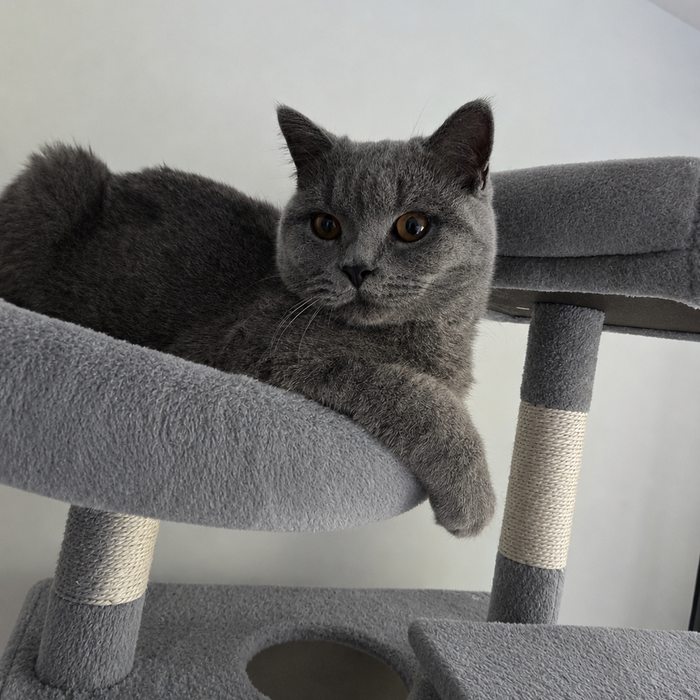
Total platform area is the sum of several surfaces; a cat rests on one surface at a time. A large total therefore does not prove that any individual perch fits a large cat. Compare the usable shape and dimensions of every intended resting place.
See how separate areas behave
The Modern Vine lists rectangular platforms of 26.5 × 49cm and 26.5 × 34.5cm. Their simple rectangular areas are 1,298.5cm² and 914.25cm² respectively, but even those figures do not show how much is occupied by a post, edge or connection.
It also lists a 35cm round perch and a 30cm hammock diameter. The projected circle areas are approximately 962cm² and 707cm², but the hammock is curved rather than a flat disc. Adding these numbers would mix different resting shapes and still would not identify a full-body surface.
Measure the uninterrupted part
Ask whether stated dimensions describe the outside edge or the clear resting surface. Note posts, raised rims, openings and attachment points. For a rectangle, record both length and width; the same square-centimetre area can be arranged in shapes that support very different postures.
Compare with the cat's actual resting outline
Observe a relaxed curl and a full side rest on a familiar surface. Record the rectangle those positions occupy without forcing the cat into a measuring session. Compare both directions with each usable platform rather than deciding from body weight or breed.
Keep area and load in separate columns
A platform can be broad enough but not have the documented load rating needed for that cat, or have a suitable rating while being too short. The current Modern Vine description lists 10–15kg per platform and asks buyers with cats over 10kg to confirm the capacity of the particular platform. Do not use surface area to calculate a new load allowance.
Check the route as well
A suitable top platform is only useful if the steps to and from it also suit the cat. Ask for spacing and clear landing areas. Our whole-route guide explains why a single generous perch does not settle access.