


The Velvet Nest — Plush Rectangular Cat Bed, 4 Sizes
Recommended size: M
A plush place to curl up, with raised sides and a washable cover.
50 × 45 × 15 cm overall
£79.99 View productA Norwegian Forest Cat’s thick coat and substantial frame can make furniture sizing difficult to judge by eye. This guide brings together breed context, everyday care and the measurements to check before buying a tower, bed or litter tray.
Explore the Large & Giant Breed Collection →
The Cat Fanciers’ Association’s Norwegian Forest Cat profile describes a sturdy, slow-maturing breed with a thick double coat. Its roots are in Norway, with organised breeding helping preserve the breed. The coat’s appearance does not make an individual cat immune to cold or wet conditions.
CFA describes an independent but sociable cat that can enjoy activity and companionship. Treat personality descriptions as context: observe the individual cat’s preferences for handling, play and resting, rather than assuming it will be quieter or more athletic than a Maine Coon.
CFA gives adult weights of approximately 12–16 lb for males (5.4–7.3 kg) and 9–12 lb for females (4.1–5.4 kg), and notes that full growth can take up to five years. These are descriptive ranges, not targets to feed towards. Ask your vet to assess body condition and growth if you are concerned.
Measure the cat rather than assigning body length, tail length or platform size from a breed table. Fur can obscure body shape; weight alone cannot tell you whether a bed has enough usable room.
Check the coat regularly and choose tools and a manageable routine suited to its texture and your cat’s tolerance. Cats Protection recommends daily brushing for long-haired cats. Keep handling gentle and seek help if your cat cannot tolerate the necessary care. Do not pull a comb through a tight mat or cut it out with scissors; ask your vet about safe removal.
Report marked changes in self-grooming, skin condition or comfort to your vet. Build dental care into the care plan with veterinary advice rather than treating occasional brushing as a complete dental programme.
The Cashmere Comb grooming set offers several grooming and care accessories. Check its current contents and learn the appropriate use of each tool; owning the set does not mean every tool is needed for your cat.
Choose a complete food suited to the cat’s life stage, following the product’s feeding guidance and your vet’s advice. Cats Protection’s feeding guidance explains life-stage choices. Slow physical maturity is not, by itself, a reason to continue kitten food for several years. Review portions against the individual cat’s condition, activity and needs, and make food changes gradually.
Ask breeders for actual screening records rather than a general assurance that the breed is hardy. The GCCF breeding policy discusses glycogen storage disease type IV (GSD IV), a serious inherited recessive disorder reported in Norwegian Forest Cats, and the availability of DNA testing. Ask your vet to interpret the laboratory results and what they mean for the particular kitten.
Heart assessment is a separate subject. Cornell’s HCM guidance explains the disease and its diagnosis. Discuss screening with your vet based on examination, history and breeding plans; this guide does not prescribe a universal scan schedule or rank one condition as every cat’s greatest risk. Trouble breathing or sudden painful loss of limb use requires urgent veterinary attention.
Provide accessible resting and hiding places, scratching options and opportunities for play. A climbing reputation does not mean that every cat should use a tall structure. Consider the approach, transitions between levels and descent, with lower options where needed.
Assess indoor and outdoor arrangements for the particular cat and home. Height and enrichment do not automatically establish that every indoor setup is suitable. In shared homes, spread resources so cats have choices beyond one tower or one narrow access route.
| Shopping for | Check before ordering | Explore |
|---|---|---|
| A tower | Usable platforms, entrances, routes between levels, full footprint and documented installation and load limits. | Cat towers and trees |
| A bed or den | Interior sleeping area, entrance height and width, selected variant and care instructions. | Beds and comfort |
| A litter tray | Usable toilet space, entry access and, for automatic models, exact operating restrictions. | Litter trays |
The Cat-Cave, Taj-MeowHall and Ultimate PawHouse offer different tower layouts to compare. Their overall dimensions do not certify individual fit or simultaneous use by several cats. Request missing interior measurements and ratings before selecting a model.
For resting options, compare the Velvet Nest using its usable interior, not just its outer measurements. The Koda Pod currently has conflicting catalogue dimensions and scratching-surface details; confirm the exact option before ordering. Product pages show current prices and selected variants.
CFA describes adult males at roughly 12–16 lb (5.4–7.3 kg) and females at 9–12 lb (4.1–5.4 kg). Individual cats vary. These figures are breed context, not ideal-weight targets or furniture dimensions.
No. A breed’s time to full physical maturity does not by itself establish how long to feed kitten food. Follow the selected food’s life-stage guidance and ask your vet about your cat’s growth and body condition.
No. Check usable resting areas, entrance dimensions, access routes and the exact product’s limits. A breed collection or overall size does not establish individual fit.
Ask for the actual parental health-screening records, including relevant GSD IV DNA results and heart-screening history. Have your vet interpret the records and explain their limits; no test guarantees lifelong health.
Use our furniture size guide to record your measurements. For a focused breed comparison, see Norwegian Forest Cat vs Maine Coon.
A little extra joy, every week
Give them a new favourite spot. Then share a photo of your cat with their Giant Paws purchase for a chance to win our £1,500 weekly draw.
Choose their favourite. Snap your cat. Enter the draw.
Shop for my cat →Already ordered? Send your photo →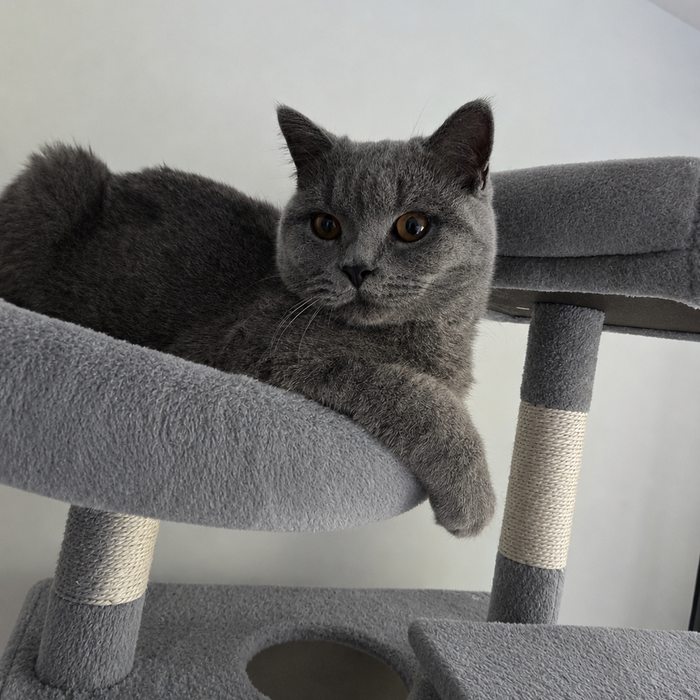


Find a new favourite for your cat. Tell us their size, your space and your budget.
1 of 3
Use this shortlist to compare. Check usable resting areas, full assembled dimensions and installation requirements on the product page before ordering.
A few other options to consider. The differences from your answers are shown on each card.
Other ideas for your cat. These may fall outside your size, space or budget choices.
Recommended size: M
A plush place to curl up, with raised sides and a washable cover.
50 × 45 × 15 cm overall
£79.99 View productRecommended size: L
A plush place to curl up, with raised sides and a washable cover.
64 × 53 × 17 cm overall
£89.99 View productRecommended size: XL
A plush place to curl up, with raised sides and a washable cover.
76 × 61 × 18 cm overall
£99.99 View productRecommended size: XXL
A plush place to curl up, with raised sides and a washable cover.
90 × 68 × 21 cm overall
£109.99 View productRecommended size: M
A soft, flat resting spot that is easy to place around your home.
40 × 50 cm
£19.99 View productRecommended size: L
A soft, flat resting spot that is easy to place around your home.
50 × 70 cm
£34.99 View productRecommended size: XL
A soft, flat resting spot that is easy to place around your home.
70 × 100 cm
£39.99 View productTwo condos and multiple resting spots, with a compact listed base.
60 × 50 cm base · 216 cm tall
£129.99 View productExtra choice for lounging and hiding, with two enclosed condos.
112 × 60 cm listed footprint · 185 cm tall
£204.99 View productA narrow base and floor-to-ceiling layout for climbing and perching.
40 × 40 cm base · requires a 240–280 cm ceiling
£369.99 View productShown option: Light Grey
£269.99 View product


