


The Velvet Nest — Plush Rectangular Cat Bed, 4 Sizes
Recommended size: M
A plush place to curl up, with raised sides and a washable cover.
50 × 45 × 15 cm overall
£79.99 View productA Bengal’s active reputation is useful context when planning a home, but furniture still needs to fit the individual cat. This guide covers breed background, everyday care and the questions to ask before choosing a tower, bed or litter tray.
Explore the Large & Giant Breed Collection →
TICA’s Bengal profile describes a muscular, medium-to-large cat whose ancestry includes domestic cats and the Asian leopard cat. TICA accepted the breed in 1986 and granted championship status in 1991.
The profile lists approximate adult weights of 6–12 lb for females (2.7–5.4 kg) and 9–15 lb for males (4.1–6.8 kg). These are descriptive ranges, not ideal-weight targets or dimensions for buying equipment. Weigh and measure your individual cat; ask your vet about growth or body-condition concerns.
TICA describes curiosity and a need for engagement, while recognising that individual Bengals differ in confidence and activity. Avoid ranking one breed’s exercise requirements against another as if every cat needs the same programme.
Offer opportunities for interactive play, scratching and exploration alongside undisturbed rest. Watch which locations and surfaces your cat chooses. A tower may be used for sleeping as well as climbing; there is no reason to dismiss either use. New vocalising, scratching or changes in activity can have several explanations, so discuss persistent changes with your vet.
Choose grooming tools suited to the coat and your cat’s tolerance, and check for skin changes or unexpected hair loss. A short coat is not a promise of no shedding or the lowest maintenance of every breed. The RSPCA’s grooming guide explains practical care and suitable tools.
Feed a complete food for the appropriate life stage and review portions against individual condition and needs. Neither an activity stereotype nor a breed-average weight is enough to set portions. Follow the selected food’s instructions and discuss kitten-to-adult transitions with your vet. See Cats Protection’s feeding guidance.
UC Davis Veterinary Genetics Laboratory describes Bengal PRA-b, an inherited recessive retinal disorder associated with blindness, and its DNA test. Ask breeders for actual laboratory reports and have your vet explain their meaning. A result for one variant does not rule out every eye condition or replace examination if vision changes.
Heart assessment is separate from an eye-disease DNA test. Cornell’s HCM guidance explains hypertrophic cardiomyopathy and diagnosis. Discuss examination and screening in light of your cat’s history, findings and breeding plans rather than assuming a universal scan schedule. Breathing difficulty or sudden painful loss of limb use needs urgent veterinary attention.
Consider accessible routes, secure windows and outdoor openings, quiet retreats and room for normal activities. A flat is not automatically suitable or unsuitable because the cat is a Bengal. In a multi-cat home, provide choices beyond a single structure and consider whether one cat can block another’s access to resources.
A taller tower does not remove the need for floor space. Measure its maximum assembled width and depth, including projecting beds, and allow the specified installation and access clearance.
| Equipment | Check | Examples to compare |
|---|---|---|
| Cat tower | Usable resting areas, entrances, routes between levels, documented load limits and installation. | Feline Sovereign Spire and Taj-MeowHall |
| Scratching option | Surface, orientation, reach and stability according to the product instructions. | Scratch Central and Paw-villian |
| Litter tray | Usable toilet area and entry access; automatic models also have specific operating restrictions. | Litter-tray range |
| Bed | Selected variant’s interior sleeping area and entry height, compared with your cat’s resting position. | Velvet Nest |
Do not choose M, L or XL solely because Bengals are described as lean. Request missing measurements before ordering. Product pages show current prices and options; the examples above are not certifications of fit for every Bengal.
Use the Giant Paws size guide and our Bengal space and enrichment article to prepare a shortlist.
TICA describes Bengals as medium-to-large and muscular. Individual dimensions vary, so measure the cat rather than selecting furniture from a breed label or weight range alone.
Suitability depends on the individual cat and the whole home, including space, resources, activity and opportunities to retreat. A tall tower and daily play do not automatically establish that every flat is suitable.
Not necessarily. Look at the circumstances, resource access and any other changes. New or persistent changes should be discussed with your vet rather than automatically attributed to insufficient enrichment.
Ask for the actual parental screening records and relevant genetic reports, including Bengal PRA-b results where applicable. Your vet can explain what the tests cover and whether a separate heart examination or other assessment is needed.
A little extra joy, every week
Give them a new favourite spot. Then share a photo of your cat with their Giant Paws purchase for a chance to win our £1,500 weekly draw.
Choose their favourite. Snap your cat. Enter the draw.
Shop for my cat →Already ordered? Send your photo →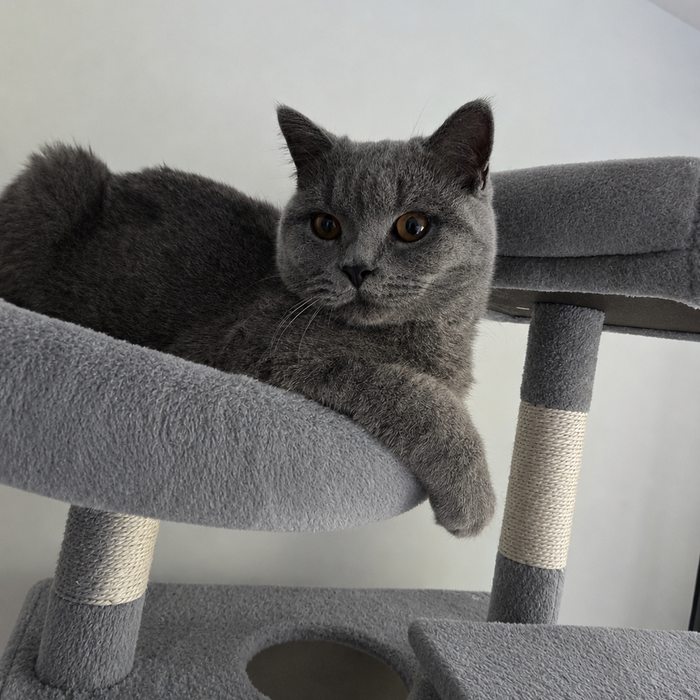


Find a new favourite for your cat. Tell us their size, your space and your budget.
1 of 3
Use this shortlist to compare. Check usable resting areas, full assembled dimensions and installation requirements on the product page before ordering.
A few other options to consider. The differences from your answers are shown on each card.
Other ideas for your cat. These may fall outside your size, space or budget choices.
Recommended size: M
A plush place to curl up, with raised sides and a washable cover.
50 × 45 × 15 cm overall
£79.99 View productRecommended size: L
A plush place to curl up, with raised sides and a washable cover.
64 × 53 × 17 cm overall
£89.99 View productRecommended size: XL
A plush place to curl up, with raised sides and a washable cover.
76 × 61 × 18 cm overall
£99.99 View productRecommended size: XXL
A plush place to curl up, with raised sides and a washable cover.
90 × 68 × 21 cm overall
£109.99 View productRecommended size: M
A soft, flat resting spot that is easy to place around your home.
40 × 50 cm
£19.99 View productRecommended size: L
A soft, flat resting spot that is easy to place around your home.
50 × 70 cm
£34.99 View productRecommended size: XL
A soft, flat resting spot that is easy to place around your home.
70 × 100 cm
£39.99 View productTwo condos and multiple resting spots, with a compact listed base.
60 × 50 cm base · 216 cm tall
£129.99 View productExtra choice for lounging and hiding, with two enclosed condos.
112 × 60 cm listed footprint · 185 cm tall
£204.99 View productA narrow base and floor-to-ceiling layout for climbing and perching.
40 × 40 cm base · requires a 240–280 cm ceiling
£369.99 View productShown option: Light Grey
£269.99 View product


