Guides

Is My Kitten a Maine Coon? How to Check by Age vs Length, Height & Weight
The most reliable way to tell if your kitten is a Maine Coon isn't how big it looks now — it's whether its length, height and weight are running ahead of its age. Here's an age-by-age checker, plus how to set up the right furniture as they grow. Read more...
The Dome's Enclosed Design, Explained
The Dome exists because most enclosed litter boxes are designed around an average-sized cat, and larger cats end up cramped, reluctant, or hanging half out of the entrance. Here's what's actually different about it.The Real NumbersThe Dome measures 46 × 46 × 64cm overall, with approximately 30% more interior space than standard enclosed litter box designs — suited to cats up to 6.8kg (15lbs). That extra interior volume is the actual point: more room to turn, dig, and posture comfortably without the enclosure itself feeling restrictive.Why Enclosed, Not OpenAn enclosed... Read more...
Senior Large-Breed Cats: When to Reconsider Furniture Layout, Not Just Cushioning
Cushioning gets most of the attention when people think about ageing cats and furniture — softer beds, orthopaedic support. But for large-breed senior cats specifically, layout often matters more than padding: where furniture is positioned, how many separate jumps it takes to reach a favourite spot, and whether a beloved perch has become physically harder to reach rather than just less comfortable once there.Why Layout Changes With AgeA large-breed cat that comfortably vaulted onto a tall platform at three years old may find the same jump genuinely difficult at ten... Read more...
How Do I Know If My Cat's Litter Tray Is Too Small?
Short answer: the clearest signs are your cat's body regularly extending over the tray's edge while they're using it, standing half-outside the tray rather than fully inside, or increasingly avoiding the tray altogether despite it being clean.Signs to Watch For Body overhang — if your cat's body or tail extends past the tray's edge while they're digging or eliminating, the tray is very likely too small for them, regardless of what the label says. Standing outside to go — a cat backing up to the very edge, or stepping fully... Read more...
How Much Floor Space Does a Large-Breed Cat Tower Actually Need?
Height gets most of the attention in large-breed cat tower marketing, but floor space — both the tower's base footprint and each platform's usable area — matters just as much, and it's the number most buyers skip past entirely.Platform Size, Not Just Tower HeightA tall tower with small platforms doesn't actually solve the sizing problem for a large breed — if your cat can't lie down fully stretched or turn around comfortably on a given level, that platform isn't genuinely sized for them, no matter how tall the overall structure... Read more...
Norwegian Forest Cat vs Maine Coon: Size Differences Owners Should Know
Maine Coons and Norwegian Forest Cats get mixed up constantly — both are big, long-haired, cold-climate breeds with tufted ears and an unmistakable presence. But they're genuinely different in build, and knowing which is which (or what your own mixed-heritage cat leans toward) matters when you're sizing furniture.Body Shape: Long vs SturdyMaine Coons are known for sheer length — a rectangular, elongated body shape, and they're regularly cited among the longest domestic cat breeds nose-to-tail. Norwegian Forest Cats tend to be a touch more compact and sturdily built, with a... Read more...
The Cream Estate: Who This Multi-Level Tower Is Really Built For
The Cream Estate isn't our tallest tower, and it isn't trying to be — it's built for cats who want somewhere private to disappear to, not just somewhere high to perch. If you're deciding whether it's the right fit for your cat, the honest answer comes down to what your cat actually does with their space, not just their size.What's Actually in the DesignThe Cream Estate is built around two spacious enclosed condos, set at different heights, connecting a ground-level entry ramp to an angled mid-level climbing ramp and a... Read more...
Under-Stimulation and Destructive Scratching in Large-Breed Cats
Destructive scratching, chewed cardboard, knocked-over plants, 3am zoomies — for large-breed cats especially, these are very often symptoms of under-stimulation rather than a temperament problem. Breeds like Maine Coons, Norwegian Forest Cats, and Bengals were shaped by ancestries that favoured high activity and problem-solving, and a home environment that doesn't offer enough outlets for that energy tends to show it.Why Large Breeds Are Especially Prone to ThisBigger cats generally need more physical space to feel satisfied, not just more floor space to walk on — vertical territory, varied textures to... Read more...
Do Large Cats Need Reinforced Furniture Bases?
Short answer: yes, generally — the bigger and more active the cat, the more a furniture base's stability matters, and a reinforced or widened base is one of the most overlooked safety features when shopping for large-breed cat furniture.Why Base Strength Matters More for Large CatsWhen any cat jumps onto an elevated platform, the landing generates far more force than the cat's standing body weight alone — a cat jumping from height can generate impact forces well above their resting weight. For a large or heavy-set cat, that impact is... Read more...
Jumbo vs Giant vs XL Litter Trays: What the Size Names Actually Mean
If you've shopped for a litter tray for a large cat, you've probably noticed the same thing we did: "Jumbo," "Giant," and "XL" get used almost interchangeably across brands, with wildly different actual dimensions behind each label. There's no industry standard defining what any of these words mean — they're marketing terms, not measurements.Why the Labels Don't Line UpUnlike, say, clothing sizing (which is inconsistent but at least loosely standardised within a country), litter tray size names are set independently by each manufacturer. One brand's "Jumbo" tray might be genuinely... Read more...
British Shorthair Cats: Do They Need Large-Breed Furniture Too?
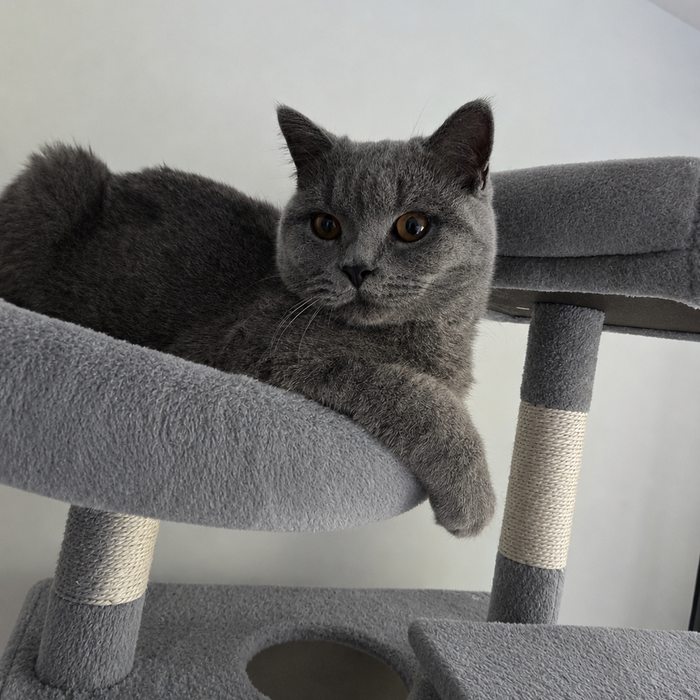
British Shorthairs aren't usually filed under "large breed" the way Maine Coons or Norwegian Forest Cats are — but ask anyone who's tried to lift a fully grown male off the sofa, and you'll hear a different story. They're not tall or long-bodied. They're dense. A well-fed adult male British Shorthair commonly sits between 5-8kg, packed into a compact, round, heavily-muscled frame — often outweighing a Maine Coon of similar height.Height vs Mass: Why the Distinction MattersMost "large breed" furniture marketing focuses on height and length — taller towers, longer... Read more...
Why Multi-Cat Households Need More Than One Vertical Level
In a multi-cat home, floor space isn't the main constraint — vertical access is. Cats naturally organise territory by height as much as by area, and a single-level setup can quietly create tension that looks like unrelated behaviour problems.Height is territoryCats use elevation to signal status and claim space without direct confrontation — a cat on a higher perch generally feels more secure than one on the floor. In a one-cat household this barely matters. In a multi-cat household, if there's only one attractive high spot, cats end up competing... Read more...
Can Two Large Cats Share One Cat Tower?
Short answer: often yes, but it depends more on footprint and platform count than on the tower simply being "big enough."What actually matters for sharingTwo large cats sharing a tower need enough separate platforms that neither has to challenge the other for a spot — a tower with only one or two usable perches tends to create competition regardless of overall size. Look for multiple distinct levels, and ideally more than one enclosed retreat, not just one large open platform.Personality matters as much as designSome cats happily co-exist on the... Read more...
Wall-Mounted Cat Shelves vs Full Cat Towers for Large Breeds
Wall-mounted shelves look sleek and save floor space, but for large-breed cats they solve a different problem than a full tower does — worth knowing before you pick one over the other.What wall shelves do wellShelves are excellent for creating a fixed climbing route up a wall, and they keep floor space completely clear — useful in smaller rooms. For a large, confident jumper, shelves need to be installed with proper wall fixings rated well above the cat's weight, since the mounting hardware (not the shelf material) is usually the... Read more...
Highland Retreat: Sizing and Positioning Guide
The Highland Retreat is our flagship activity centre, and it's built at a scale that needs a bit of planning before it arrives — this guide covers the real dimensions and where it tends to work best in a home.The real numbersThe Highland Retreat stands 196.9cm tall with a 208.8cm footprint width, putting it firmly in floor-to-ceiling statement-piece territory rather than a corner accessory. It includes a treehouse-style penthouse with a window and ventilation slats, a built-in exercise wheel, an angled sisal-surfaced ramp/slide, and multiple tiered platforms, all built from... Read more...
Static vs Dynamic Weight: Why Jumping Matters More Than Standing Weight
When people worry about whether a piece of furniture can "hold" their cat, they're usually picturing the cat sitting or standing on it. But for large, athletic breeds, the moment of real stress on a structure isn't standing still — it's landing.What static weight actually measuresStatic weight capacity describes how much a surface can hold at rest, evenly distributed, not moving. It's the easiest condition for almost any structure to survive, and it's also the number most commonly advertised — because it's the simplest to test.Why dynamic (jumping) load is... Read more...
Why Do Maine Coons Destroy Furniture? (It's Usually Boredom, Not Bad Behaviour)
If your Maine Coon has taken an interest in the sofa arm or a table leg, the instinct is to call it "naughty." In most cases that's the wrong read. Scratching and destructive-seeming behaviour in large, intelligent breeds like Maine Coons is very often a symptom of under-stimulation, not a discipline problem.It's an instinct, not a choice to misbehaveScratching is a normal cat behaviour — it conditions claws, marks territory, and stretches muscles. Maine Coons, being large, strong, and highly active, often need more of it than an average cat,... Read more...
Cat Tower Weight Limits Explained: What the Numbers Actually Mean
"Weight limit" on a cat tower listing sounds like a simple number, but it's often more marketing shorthand than a tested engineering spec. Here's what actually matters when you're judging whether a tower can handle a large-breed cat, based on general industry guidance rather than any single product's claim.Static weight isn't the real testA cat standing still on a platform is the easiest case for any structure to handle. The real stress comes from dynamic load — the force generated when a cat jumps up or down. A cat landing... Read more...
Siberian Cat Size & Care Guide
Siberian cats are one of the largest naturally occurring cat breeds, known for a dense, weather-resistant triple coat and a build that's more muscular than most domestic cats. If you're comparing furniture sizing across breeds, Siberians sit closer to Maine Coons and Norwegian Forest Cats than to an average moggy — worth knowing before you buy anything sized for a "standard" cat.How big do Siberian cats get?Adult males typically weigh 4.5–9kg, with females usually 3.5–7kg. Combined with a long, thickly-furred body, a Siberian can look — and need to move... Read more...
What the Feline Sovereign Spire's Adjustable Height Range Is Actually For
The Feline Sovereign Spire adjusts between 240cm and 280cm — here's why a floor-to-ceiling design needs that range, and who actually benefits from it. Read more...
Choosing Between the Bothy and the Gentleman's Abode
Both are self-cleaning litter trays built for large cats — here's how the Bothy and the Gentleman's Abode actually differ, and which suits which household. Read more...
The Cat-Cave's Enclosed-Den Design, Explained
Why the Cat-Cave pairs a 210cm tall tree with an enclosed, den-like condo, and what that combination is actually built to solve for large cats. Read more...
Inside the Taj-MeowHall: Built for Multi-Cat, Large-Breed Homes
Why the Taj-MeowHall's 185cm frame, two enclosed condos and hammock level are built around multi-cat, large-breed households specifically. Read more...
Why the Ultimate PawHouse Is Sized the Way It Is
A look at the real dimensions behind the Ultimate PawHouse — 216cm tall with over 1m² of platform space — and why those specific numbers matter for a large-breed cat. Read more...
Grooming Needs of Long-Haired Large-Breed Cats
Maine Coons, Ragdolls, and Norwegian Forest Cats all carry dense, long coats that need real maintenance. Here's a practical guide to frequency, tools, and preventing mats. Read more...
Managing a Multi-Cat Household With Large Breeds
Two or more large-breed cats under one roof takes more than double the planning. Here's how to allocate litter trays, feeding stations, and vertical space to keep the peace. Read more...
Signs Your Cat's Furniture Is Too Small
If your large-breed cat is hanging off the edges of their bed or avoiding their tower altogether, undersized furniture is likely the culprit. Here's a practical checklist to spot the signs. Read more...
Why Large Cats Need More Vertical Space
Vertical space isn't a luxury for large-breed cats — it's a core behavioural need rooted in territory, security, and exercise. Here's the science behind why height matters so much. Read more...
Arthritis in Senior Large-Breed Cats: Furniture Adjustments That Help
Feline arthritis is far more common than most owners realise, especially in senior large-breed cats. Here's how to recognise the signs and adjust your cat's furniture to keep them comfortable. Read more...
Do Large Cats Need Special Beds?
Yes — size, joint support and material durability all work differently for a heavy, long-bodied cat than for an average-sized one. Here's why it matters. Read more...
How Often Should You Clean a Self-Cleaning Litter Tray?
Self-cleaning doesn't mean zero-maintenance — here's a realistic daily, weekly and monthly cleaning schedule for automatic litter trays. Read more...
Can Kittens Use Large-Breed-Sized Cat Furniture?
Large-breed kittens grow slowly — a Maine Coon can take 3-5 years to reach full size — so here's what to actually consider before putting a kitten on adult-sized furniture. Read more...
How Much Weight Can a Cat Tower Actually Hold?
Load ratings for cat towers depend on construction, not marketing — here's how to read them properly and what to ask a supplier before you trust a number. Read more...
Do Maine Coons Need Bigger Litter Trays?
Yes — a Maine Coon's body length, digging habits and typical entry openings mean the standard tray you'd buy for a moggy is usually too small. Here's the reasoning, not just the recommendation. Read more...
How to Choose an Elevated Feeder for a Large-Breed Cat
A practical buying guide to elevated cat feeders for big breeds, covering bowl height and posture, material choice between ceramic, bamboo and silicone, and what to check before buying. Read more...
Sisal vs Carpet Scratching Posts for Large Cats: Which Holds Up Better?
A genuine durability and appeal comparison of sisal versus carpet scratching posts for heavier, powerful-clawed cat breeds, plus what to look for in construction and base stability. Read more...
Self-Cleaning vs Manual Litter Trays for Large Cats: The Honest Tradeoffs
A genuine comparison of self-cleaning and manual litter trays for big cat breeds, covering cost, reliability, whether cats actually accept the mechanism, and real maintenance demands. Read more...
Cat Tower vs Cat Tree: What's the Real Difference (and What Big Cats Actually Need)
Cat towers and cat trees are often used interchangeably, but the terminology and construction differ. Here's what large-breed owners should actually look for in platform size, base stability and materials. Read more...
Enclosed vs Open Litter Trays for Large Cats: Which Is Actually Better?
A balanced look at enclosed versus open litter trays for Maine Coons, Ragdolls and other big breeds, covering odour control, privacy, entry size, cleaning and floor space. Read more...
Do Large-Breed Cats Need Different Furniture Than Average Cats?
A breed-by-breed look at why large and high-energy cat breeds outgrow standard pet furniture, and the buying principles to use instead of guessing. Read more...
Bengal Cat Space and Enrichment Needs: Size, Energy and What They Actually Require
Real Bengal cat size data plus a practical look at why this athletic, high-energy breed needs more climbing space and daily enrichment than an average cat. Read more...
Savannah Cat Space and Enrichment Needs: Size, Energy and What They Actually Require
Real Savannah cat size data plus a practical look at why this exceptionally athletic breed needs more vertical space and activity than a typical domestic cat. Read more...
Norwegian Forest Cat Size Guide: Real Weight, Length and Height Ranges
An evidence-based guide to Norwegian Forest Cat size — weight, length, height and growth timeline — and what these big, forest-adapted cats need from their furniture. Read more...
Ragdoll Cat Size Guide: Real Weight, Length and Height Ranges (And What They Mean for Furniture)
A factual look at how big Ragdoll cats really get — weight, length, height and growth timeline — and what those numbers mean when you're choosing a cat tower, bed or scratching post. Read more...
Maine Coon Size Guide: How Big Do They Really Get? (+ Furniture Sizing Chart)
Real Maine Coon weight, length and height ranges, and what they mean for choosing cat towers, beds and litter trays sized for large breeds. Read more...