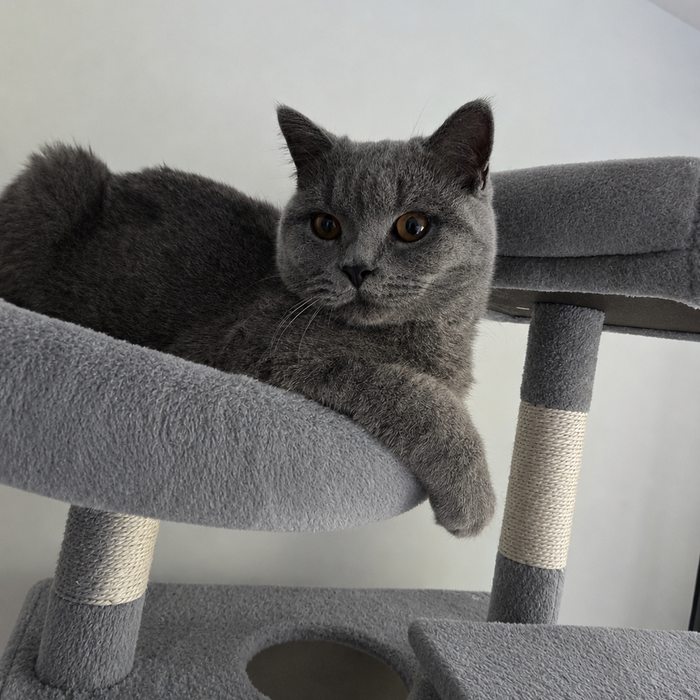
A floor-to-ceiling cat tree can offer elevated resting and climbing options where the room and the individual cat suit the design. Before comparing finishes, confirm the selected model’s installation requirements, full footprint, load limits and accessible routes.
Start with the exact installation method
Many floor-to-ceiling models use tension or compression between supporting surfaces. Designs differ, so do not assume that every model is freestanding, requires no drilling or can be fitted to any ceiling. Read the manufacturer’s assembly instructions before ordering, including any required wall fixings or restrictions on ceiling and floor construction.
If the instructions do not establish suitability for your surfaces, ask the supplier before buying. Do not improvise extensions, packers or extra tension to make an incompatible model fit.
Measure more than ceiling height
| Check | What to confirm |
|---|---|
| Ceiling clearance | Height at the intended installation point falls within the exact model’s permitted range. |
| Supporting surfaces | Floor and ceiling meet the manufacturer’s requirements, including any restrictions on slopes or finishes. |
| Full footprint | Maximum assembled width and depth include projecting beds, steps and hammocks. |
| Access and clearance | Doors, household routes and the space needed for assembly, inspection and cleaning remain usable. |
The Modern Vine currently lists an adjustable height of 230–250 cm and a base of 54 × 34 cm. The base measurement alone does not describe its full projecting footprint. Check the selected listing and instructions, and request any missing dimensions before deciding it fits.
Compare usable surfaces and routes
Measure your cat’s preferred resting position against the usable bed or platform area, allowing for posts and raised edges. Check the first step, gaps between levels and the descent. A narrow layout can still be difficult to navigate, and the tallest option is not automatically the most useful.
For several cats, confirm any simultaneous-use restrictions and component load limits. Multiple perches do not guarantee that all cats can share the structure comfortably. Provide other resting choices around the home.
Assess stability from specifications and installation
Price, a thick-looking pole or a wide base in a photograph does not establish a tested load capacity. Ask for the documented limits and follow the complete installation method. Inspect and maintain fixings as instructed; stop use if the structure loosens or becomes damaged. Do not calculate a new load allowance from the cat’s jump height.
Check cleaning and replacement details
Confirm which covers are removable, which components can be washed or wiped, and whether replacement scratching sections are actually available for that model. Wood, board, fabric and rope need different care. “Easy-clean” styling is not a substitute for care instructions.
Compare Giant Paws cat towers and trees using the size guide. Keep a shortlist of models whose documented fit and installation suit your home, then choose among their layouts and finishes.
Frequently asked questions
How tall should a floor-to-ceiling cat tree be?
Its permitted adjustment range must include the measured height at the installation point. Follow the exact model’s surface and assembly requirements rather than assuming a standard ceiling height.
Are floor-to-ceiling cat trees suitable for large cats?
Some may be, but check documented load limits, usable resting areas, access routes and installation requirements for the particular model and cat.
Do floor-to-ceiling cat trees require drilling?
Installation methods differ. Check the exact model’s instructions for any required fixings; the floor-to-ceiling description alone does not mean no drilling is needed.
Which material is easiest to maintain?
Compare the actual care instructions and removable components. Washability and replacement parts depend on the model, not just the material’s name.