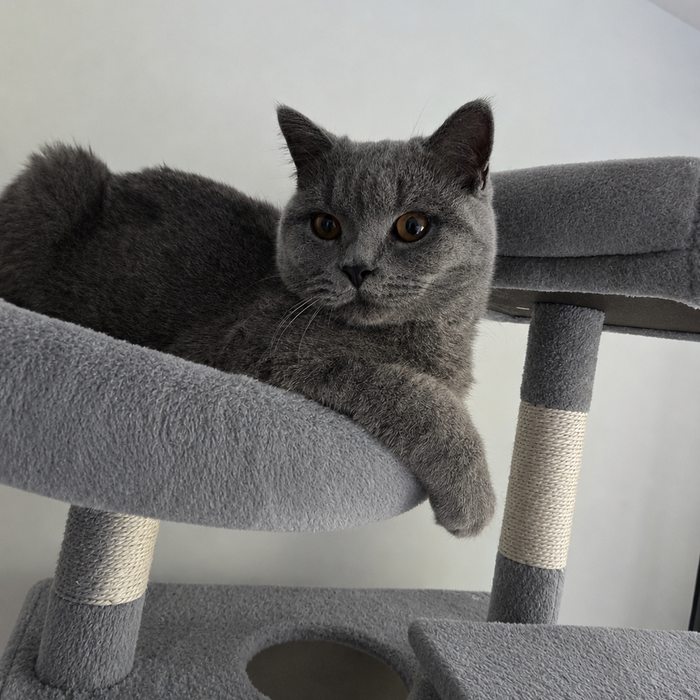
A toy attached to a tower and a wand you move yourself offer different kinds of interaction. One is tied to a fixed location; the other lets you vary the route and pace. Neither format removes the need to inspect the toy and consider the space around it.

Think about who controls the movement
With a wand, you can pause, change direction and keep the game at a suitable level. An attached toy moves within the limits of its fixing. Observe whether your cat likes to follow a moving target or bat something in a familiar place before adding more of the same format.
Check the whole play area
Keep the route clear of fragile objects, cables and awkward landings. Do not use a wand to draw the cat into a jump the furniture is not intended to support. The Paw-villian has attached play elements, but those should be assessed with the surrounding floor space as well as the board itself.
Inspect cords and small components
Look for loose attachments, exposed filling and damage. Follow the product's supervision guidance and remove damaged toys from access. Cats Protection cautions against leaving cats alone with toys that can be shredded, swallowed or cause entanglement. A toy being attached to furniture does not make that concern disappear.
Put the supervised equipment away
Store wand toys securely after use, with their strings and attachments out of reach. Keep a separate place for toys awaiting repair or disposal so they are not returned to the rotation accidentally. Choose a short, manageable game that you can repeat rather than relying on a furniture feature to provide all interaction.
Explore the play features in the Giant Paws range as part of a varied routine. Check what is included in the selected product and which elements need supervision.