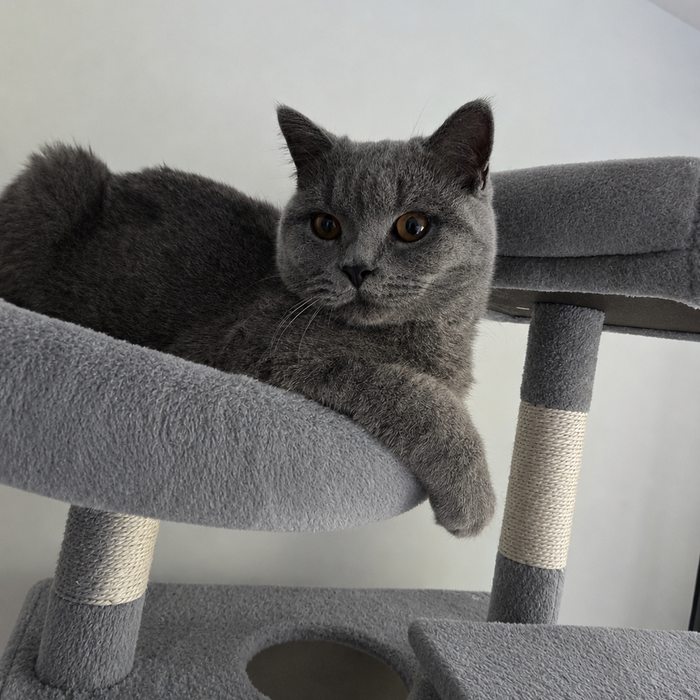
The short answer: yes, and it's not just about size
Most cat furniture sold in general pet shops is designed around an "average" cat — roughly 3.5–4.5 kg, around 23–25 cm at the shoulder, with a fairly standard body length. That works fine for a huge proportion of cats. It works far less well for the growing number of popular large and high-energy breeds now common in UK homes: Maine Coons, Ragdolls, Norwegian Forest Cats, Savannahs and Bengals among them. The mismatch isn't only about a bigger cat needing a bigger box — it's that different breeds are large or active in genuinely different ways, and that changes what "good furniture" actually looks like.
Two different problems: raw size, and energy
It helps to separate large-breed furniture needs into two categories, because they call for different solutions.
1. Cats that are simply bigger
Breeds like the Ragdoll and Norwegian Forest Cat are substantially heavier and longer-bodied than an average cat — Ragdoll males commonly reach 6.8–9 kg, and Norwegian Forest Cat males a similar 5.5–9 kg, both considerably above the 3.5–4.5 kg typical of an average domestic cat. Maine Coons, one of the most recognisable oversized breeds, follow a similar pattern. For these cats, the core issue is that standard platforms, entry doors and bases are undersized and under-braced for the actual weight and length involved — a 60 cm long, 8 kg adult stretched across a shelf built for a 4 kg cat is asking a lot of both the shelf and its fixings.
2. Cats that are athletic, energetic, or both
Savannahs and Bengals present a different challenge. Savannahs, particularly early-generation cats, can weigh up to around 11 kg with an exceptionally leggy build and reported jumping ability in the region of 2.4–2.7 m from a standing start. Bengals aren't dramatically larger by the numbers, but their dense, muscular build and high activity drive mean they use furniture constantly and forcefully rather than occasionally. For both breeds, the limiting factor usually isn't platform size — it's height, stability under repeated launching and landing, and simply having enough vertical territory to satisfy an energetic cat before it finds its own, less appropriate, alternative (worktops, curtains, wardrobes).
A quick comparison across breeds
| Breed | Typical adult weight | Main furniture consideration |
|---|---|---|
| Ragdoll | 4.5–9 kg | Wide, supportive platforms and beds for a heavy, sprawling body; sturdy bases |
| Norwegian Forest Cat | 3.6–9 kg | Genuine height and deep platforms for a tall, enthusiastic climber |
| Savannah | 5.5–11 kg (varies by generation) | Very tall structures and secure landings for exceptional jumpers |
| Bengal | 3.2–6.8 kg | Multi-level, high-activity structures that hold up to frequent, forceful use |
Why "will it fit" is the wrong question
The natural instinct when buying for a large or active breed is to check whether the cat will physically fit on a product. That's necessary but not sufficient. The better questions are: will this platform still be comfortable when the cat is fully grown, not just at today's kitten or juvenile size — several of these breeds (Ragdolls and Norwegian Forest Cats especially) don't reach full maturity until three to five years old. Will the base stay stable when a heavier or more athletic cat jumps down at speed, rather than just standing on it. And will there be enough going on — height, multiple levels, scratching, a den to retreat to — to actually match the breed's normal behaviour, not just its measurements.
Buying by breed profile, not by "cat-sized"
In practice, this means starting from the breed (or breed mix) rather than a generic size chart:
- For a heavier, floor-loving breed like a Ragdoll, prioritise wide platforms and a genuinely supportive bed over sheer height.
- For a tall, natural climber like a Norwegian Forest Cat or Maine Coon, prioritise real vertical height and deep, stable platforms.
- For an exceptionally athletic breed like a Savannah, prioritise maximum height and a rock-solid base built for repeated jumping.
- For a high-energy, engaged breed like a Bengal, prioritise multiple levels and built-in activity, not just one large perch.
This is the thinking behind our range — pieces like the Feline Sovereign Spire (adjustable 240–280 cm) and the Ultimate PawHouse (216 cm tall, with over 1 m² of platform space) are built around the dimensions and behaviour of genuinely large and active breeds, rather than scaled-up versions of a standard cat tree. Our size guide sets out exact platform, entry and height dimensions across the range so you can match a piece to your cat's actual breed profile rather than its current, possibly still-growing, size. If you're between sizes or unsure, our shipping & returns policy covers what to do if a piece doesn't turn out to be the right fit.
The underlying principle holds regardless of breed: big cats break small products, not because they're badly behaved, but because they were never the customer the product was designed for. Furniture built around real breed dimensions and real breed behaviour, from the cat towers & trees range and beyond, tends to last a great deal longer as a result.
Frequently asked questions
Is large-breed cat furniture just standard furniture made bigger?
Not really. Larger platforms matter, but breed-specific needs go further — a Savannah needs height and a stable landing for jumping, a Ragdoll needs wide, supportive resting space for a heavier, sprawling body, and a Bengal needs multiple active levels rather than one bigger perch. Simply scaling up dimensions misses these differences.
At what age should I buy adult-sized furniture for a large-breed kitten?
Because breeds like the Ragdoll and Norwegian Forest Cat don't reach full maturity until roughly three to five years old, it's generally worth sizing furniture to the breed's typical adult range from early on, rather than to the kitten's current size, to avoid replacing it partway through growth.
Do high-energy breeds like Bengals and Savannahs really need more than a standard cat tree?
Generally, yes. Both breeds are well documented as unusually active and athletic, and a standard, low cat tree typically doesn't provide enough height or activity to meet that drive — which often shows up instead as counter-surfing, destructive scratching or jumping on furniture not meant for cats.