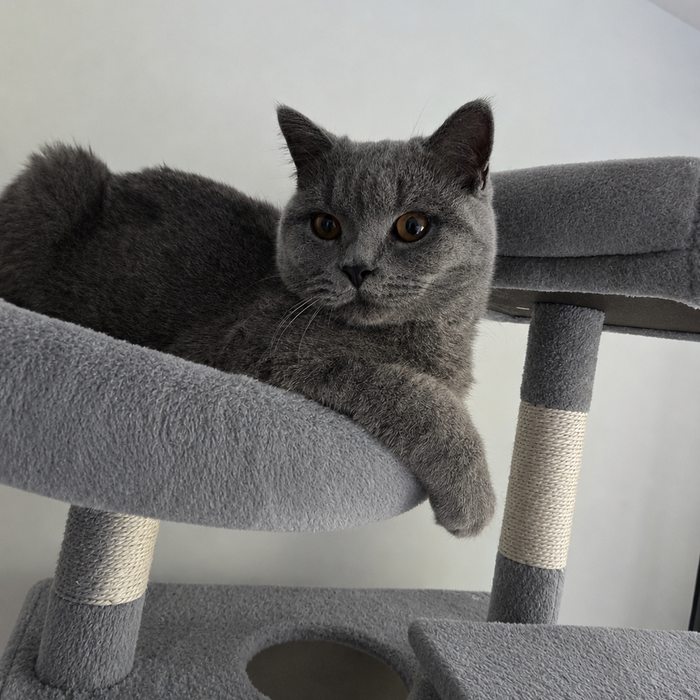
How big do Norwegian Forest Cats get?
The Norwegian Forest Cat ("Wegie") developed its size and coat naturally, surviving harsh Scandinavian winters largely on its own before being formally recognised as a breed in the 20th century. That background shows up in the cat you get today: a large, muscular, long-bodied breed with a thick double coat, strong hind legs built for climbing and jumping, and a bushy tail that adds significantly to overall length. Breed standards from bodies such as TICA and the CFA describe the Norwegian Forest Cat as one of the larger natural breeds, and real-world size bears that out.
Norwegian Forest Cat weight, length and height ranges
As with any breed, individual variation is normal — neutering status, lineage and diet all affect final size. The ranges below reflect what's typically reported for healthy adults of the breed.
| Measurement | Adult male | Adult female | Average domestic cat (for comparison) |
|---|---|---|---|
| Weight | 5.5–9 kg (12–20 lb) | 3.6–5.5 kg (8–12 lb) | 3.5–4.5 kg |
| Body length (nose to base of tail) | Approx. 45–55 cm | Approx. 40–48 cm | Approx. 40–46 cm |
| Nose-to-tail-tip length | Can exceed 90–100 cm with a full tail | Typically 80–90 cm | Approx. 70–80 cm |
| Shoulder height | Approx. 30–40 cm | Approx. 28–35 cm | Approx. 23–25 cm |
The shoulder height figure is the one that most distinguishes this breed from an average cat, and from breeds like the Ragdoll: Norwegian Forest Cats stand notably taller and leggier, with long hind legs built for climbing that give them a rangier, more athletic silhouette than their weight alone suggests.
Growth timeline: a slow-maturing breed
Like several large natural breeds, Norwegian Forest Cats take considerably longer than average to reach full adult size:
- 0–12 months: Kittens grow quickly in height and length but remain visibly lean and "leggy" — the dense double coat and muscular fill-in come later.
- 1–2 years: Frame is largely established; the breed's signature thick coat, ruff and britches develop more fully.
- 2–4 years: Continued filling out in muscle, chest depth and coat density. Many breeders and vets consider the breed fully mature around four to five years old — one of the slower maturation timelines among common breeds.
Because this maturation runs so long, a Norwegian Forest Cat that already looks large as a yearling can still add meaningful height, reach and weight over the following two or three years — worth bearing in mind if you're sizing a tower or scratching post around a young cat.
What this means for furniture and enrichment
Norwegian Forest Cats are natural, enthusiastic climbers — bred by circumstance to move confidently through trees and rough terrain, with strong claws and powerful hind legs. That combination of size, height and climbing instinct changes what to look for in furniture:
- Vertical height matters more than for a floor-loving breed — this is a cat that will use a tall tower, not just tolerate it.
- Platforms need a wider, deeper surface to comfortably hold a long-bodied, 5–9 kg adult, especially at the top perch where they like to survey a room.
- Scratching posts need real height and a stable base — a leggy, long-reaching cat needs a post tall enough to fully extend on, anchored well enough not to tip during a determined scratch or launch.
- The dense double coat needs regular grooming, particularly through seasonal moults, to avoid matting around the ruff and britches.
Given the breed's height and enthusiasm for climbing, a genuinely tall, multi-level tower tends to suit Norwegian Forest Cats better than a low, wide one. Options like The Highland Retreat or The Cream Estate — both designed with large, heavy-bodied climbing breeds in mind — offer the platform depth and multi-level structure this breed tends to make full use of. Browse the full cat towers & trees range and check platform dimensions against your cat's current and expected adult size using our size guide.
For coat care through the breed's heavier shedding seasons, a proper long-coat grooming set — such as the Cashmere Comb grooming set — makes it easier to keep on top of the undercoat before it mats.
Frequently asked questions
How much does an adult Norwegian Forest Cat weigh?
Adult males typically weigh 5.5–9 kg, while adult females are generally lighter, at around 3.6–5.5 kg. Individual cats vary depending on lineage, neutering status and overall condition.
Are Norwegian Forest Cats bigger than an average cat?
Yes. They're consistently classed as one of the larger natural cat breeds, standing notably taller at the shoulder than an average domestic cat, with a longer body and bushier tail adding to their overall size.
How long does it take a Norwegian Forest Cat to reach full size?
This is a slow-maturing breed. While the skeletal frame is largely set by around two years, most Norwegian Forest Cats aren't considered fully mature — in muscle, coat and chest depth — until around four to five years of age.