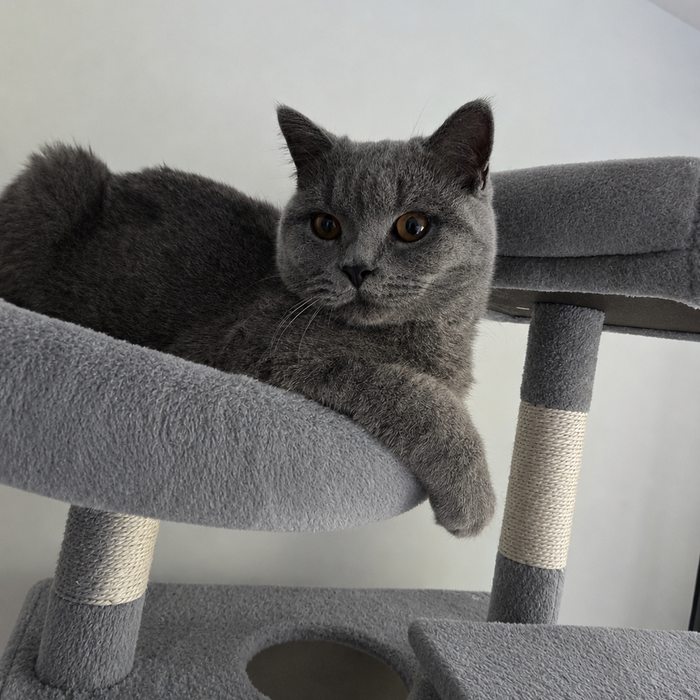
A cat sitting on a perch and a cat landing on it create different loading conditions. Understanding that distinction helps you ask better questions about product ratings; it does not let you calculate a safe limit for a tower from its photograph.
Static and dynamic describe different situations
A static load is applied without changing over time. During a landing, the cat slows down and the forces on the structure change. The force depends on more than body mass: landing speed, how quickly the motion stops and the way the load is transferred all matter.
OpenStax’s explanation of impulse and collisions relates average net force to the change in momentum over time. A jump height on its own therefore cannot establish a universal impact-force figure. Real landings also involve movement of the cat and the structure, so a simplified physics example is not a furniture test.
What this changes when shopping
- Ask what the published rating covers and how the manufacturer assessed it.
- Ask whether the documentation addresses repeated use as well as a single applied load.
- Check which platforms or hammocks have separate limits.
- Follow the specified installation and inspection instructions.
Do not invent an extra “jumping allowance” or use a general multiplier as a substitute for the product’s rating. If a tower becomes loose, damaged or unstable, stop using it and resolve the issue according to the manufacturer’s instructions.
Use our supplier-question checklist and weight-rating guide when comparing models.
Questions buyers ask
Can jump height tell me the force on a perch?
Not by itself. You also need information about the landing motion and stopping time, and a simplified calculation still does not establish the tower’s tested capacity.
Does a static test prove repeated jumping performance?
Not on its own. Ask what the documented test conditions cover rather than assuming one kind of assessment proves another.