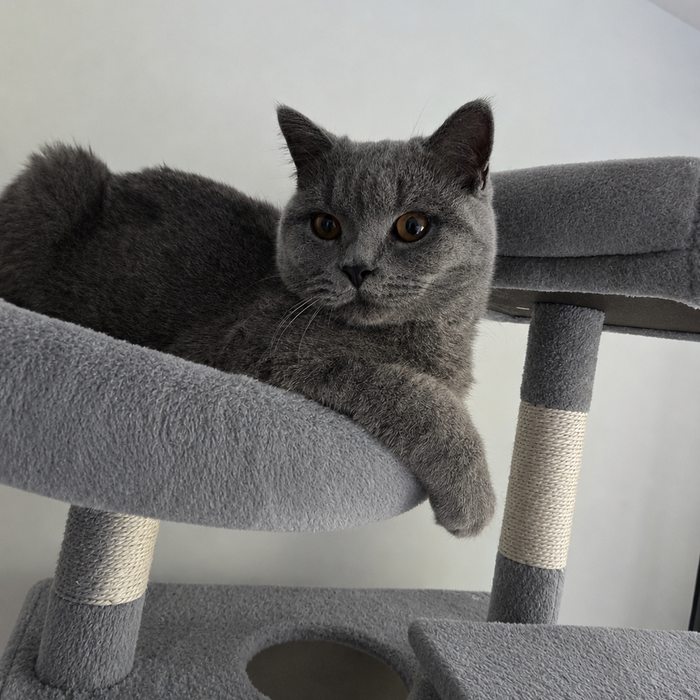
Several accessible resting places can give cats more choice. The aim is not simply to stack more platforms above one another, but to let each cat reach a comfortable spot without being forced into an unwanted interaction.
Spread options around the home
The AAFP and ISFM environmental needs guidelines recommend resources in multiple locations. Separate resting and hiding places can provide independent access; several perches clustered on one tower do not necessarily do that.
Review the routes
- Look for narrow approaches where one cat can block another.
- Include accessible lower resting places as well as elevated options.
- Check how each cat gets down, not just how it climbs up.
- Compare usable surface sizes and follow the furniture’s mounting instructions.
Floor space remains important. Elevation is not a simple social ranking system, and a cat choosing a lower spot does not by itself indicate that it has “lost” territory.
Observe changes without guessing their cause
Avoidance, blocking or a change in use can prompt a review of the setup. They do not prove that the home needs a taller tower. New toileting changes or other behaviour changes warrant veterinary advice rather than being attributed to a shortage of height. The 2024 AAFP intercat tension guidance addresses recognising and managing tension between cats.
See whether two cats can share a tower for product checks, and our multi-cat household guide for food, water and litter resources.
FAQ
Does one large tower solve space-sharing problems?
Not necessarily. Several levels can still share one access route. Provide choices in separate locations and consider the cats’ relationships, mobility and individual preferences.